How to Convert a Recipe from Cups to Grams, Step by Step
Why convert at all
Cups are quick but inconsistent. Grams give the same result in any kitchen, let you scale a recipe up or down without awkward fractions, and cut the washing up. If you follow recipes from US websites and your scale is metric, converting is the most useful kitchen habit you can build.
The method
- Write down the ingredient list with the amounts.
- Find the weight of one cup for each dry ingredient. Use our cups to grams converter or a reference chart.
- Multiply the cups by that weight.
- Round the result. Round to the nearest 5 g above 50 g, and keep the exact figure for small amounts.
- Weigh liquids in ml or grams. Water and milk are about 1 g per ml.
- Keep eggs, cloves and other whole items as counts.
A worked example
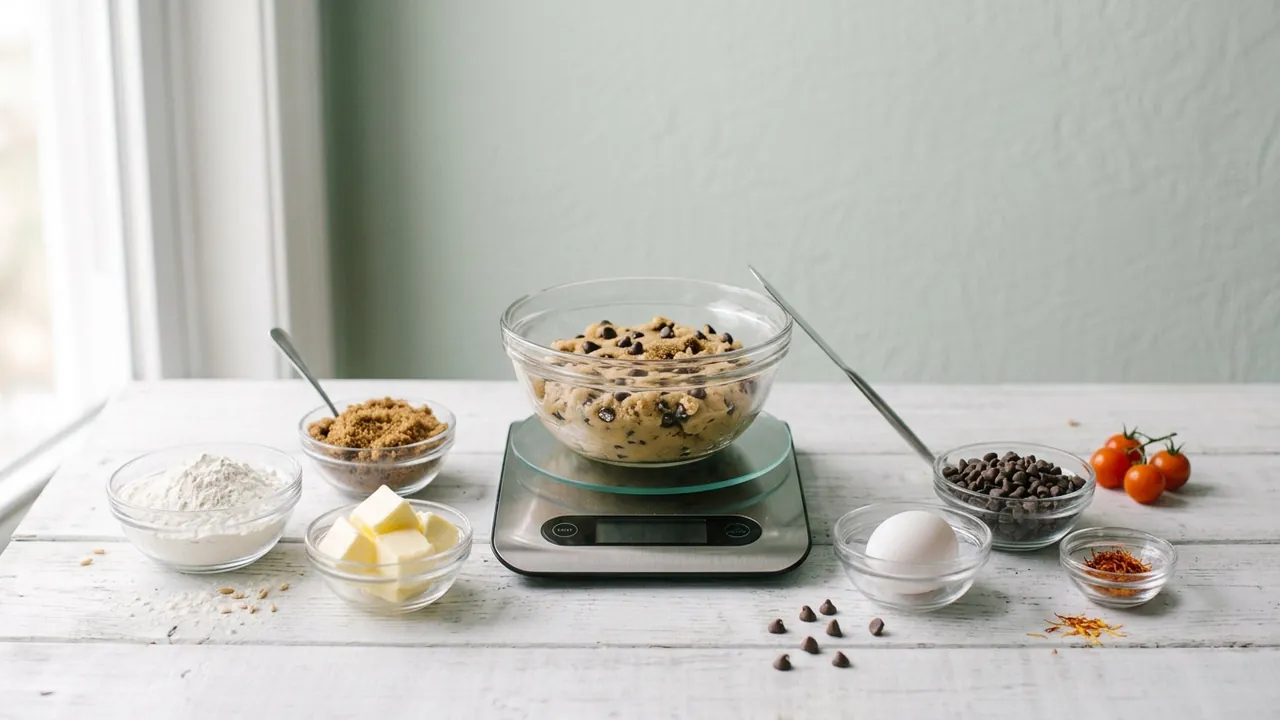
Take a simple cookie recipe.
| Ingredient | In cups or spoons | Grams |
|---|---|---|
| All-purpose flour | 2 1/4 cups | 280 g |
| Baking soda | 1 tsp | 5 g |
| Salt | 1 tsp | 6 g |
| Butter | 1 cup | 225 g |
| Granulated sugar | 3/4 cup | 150 g |
| Brown sugar (packed) | 3/4 cup | 160 g |
| Eggs | 2 large | 2 eggs |
| Chocolate chips | 2 cups | 340 g |
For flour, 2.25 cups times 125 g is 281 g, rounded to 280 g. Butter is easy because a US stick weighs 113 g, which is half a cup, so a cup is two sticks or about 225 g.
Small amounts and spoons
For teaspoons and tablespoons, weights depend on the ingredient. One tablespoon of flour is about 8 g, sugar about 12 g and butter about 14 g. For very small amounts, such as baking powder or yeast, a scale with 1 g steps cannot measure them precisely, so use measuring spoons for those even in a metric recipe. Some bakers buy a small scale with 0.1 g accuracy for this.
Liquids
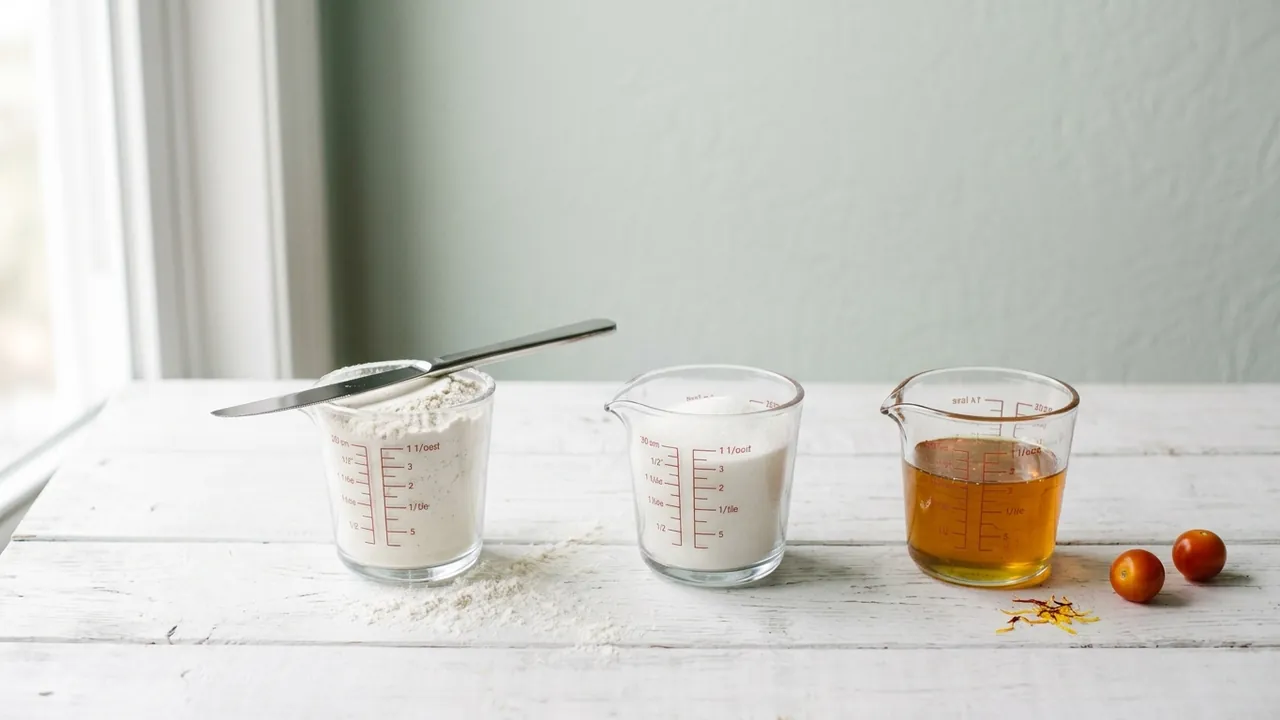
Water and milk weigh almost the same as their volume in ml. Oil is lighter, at about 0.9 g per ml, and honey is heavier, at about 1.4 g per ml. If a recipe gives ml and you have a scale, you can weigh water and milk in grams, but weigh oil and honey by grams from a chart rather than by ml.
Scaling the recipe
Once the recipe is in grams, scaling is simple. For a half batch, divide every weight by two. For a 50% larger batch, multiply by 1.5. Eggs are the awkward one. To halve an egg, beat it and use half by weight (a large egg is about 50 g without the shell). Our recipe converter scales servings automatically.
Mistakes to avoid
- Converting only some ingredients and leaving others in cups. Convert everything or nothing.
- Using the wrong flour. Bread flour and cake flour have slightly different weights per cup than all-purpose.
- Forgetting that brown sugar is packed.
- Rounding away small amounts such as salt and leavening.
- Trusting a conversion for sticky ingredients such as honey, syrup and peanut butter without checking the weight on the pack.
Check your result
When you try a converted recipe for the first time, look at the dough or batter. If a cookie dough feels much stiffer or looser than the recipe describes, an ingredient may be off. Adjust and write down what worked. Next time, you will have your own exact weights.
The short version
Convert each dry ingredient using weight per cup, keep liquids in ml, count the eggs, and round sensibly. The recipe converter does the work when you paste an ingredient list.
Frequently asked questions
How many grams is a stick of butter?
A US stick is 113 g, which equals half a cup.
Do I convert eggs to grams?
Usually no. Use the count. A large egg without shell is about 50 g if you need to scale.
What is the easiest way to convert a whole recipe?
Paste the ingredient list into the recipe converter. It converts and scales it for you.
 Why a Cup of Flour Weighs Different Amounts
 Oven to Air Fryer Conversion
 Raw vs Cooked Weight